Wednesday, April 25, 2012

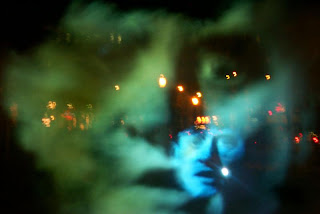
Tony Oursler's Influence Machine

Tony Oursler (born 1957) is a New York based multimedia artist. I must admit I despise almost everything the man has ever produced. I find both his early and recent works to be conceptually and aesthetically offensive and generally puerile. However in 2000 he was commissioned by the Public Art Fund to create a series of works known both collectively and individually as the  "Influence Machine". These works may be somewhat subdued, pretty public art without the concupiscent orifices of his other projections, and in terms of conceptual or intellectual merit I can't exactly argue in their defense, however as pretty works of public art I find them so delightful I couldn't resist posting them.
T.J. Clark also wrote quite an interesting piece on Ousler's work as well as that of de Chirico and Manet for the MIT press, entitled Modernism, Postmodernism, and Steam, which is certainly worth reading if any of the images catch your fancy.




Friday, April 20, 2012

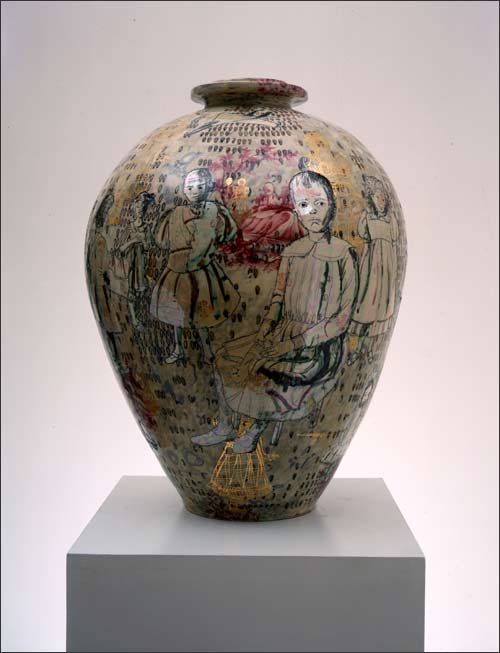
Grayson Perry

Grayson Perry (born 1960) is an English potter and fashion icon, well I suppose not everyone would call him a fashion icon, but I certainly would. Anyway, he was the recipient of the Turner Prize in 2003, and honor to which he responded with the following statement 
""Well, it's about time a transvestite potter won the Turner Prize."
His female alter-ego is named Claire and has been described by the artist himself in a number of ways including, but not limited to "“a 19th century reforming matriarch" "a middle-England protester for No More Art"  "an aero-model-maker" "an Eastern European Freedom Fighter” and “a fortysomething woman living in a Barratt home, the kind of woman who eats ready meals and can just about sew on a button.”
He deals often with child abuse and teddy bears.


Saturday, April 14, 2012

Meadham Kirchoff

Designers Ed Meadham and Ben Kirchoff are geniuses. Their Spring/Summer 2012 collection is a brilliant holocaust of candy-coated, Koonsian, couture. While this is indeed the case, and the designs are as critically complex as the aforementioned master of meta-kitsch, I must implore you, dear reader, give no heed to the facile analysis backed only by authorial authority supplied by dear, sweet, simple Ben and Ed. Be loathed to evaluate these works as some flimsy and diffuse critique of fashion's manipulations and deformations of femininity, a subject which I might mention seems the focus of every runway show since chauvinism was chic. Instead attempt to understand them as examples of Koons' new language, a symbol system born of the vacuity of consumer culture, not concerned with this vacuity, but rather exploiting it as a vessel for modern communication, the emptiness of an effective sign. They are works of semiotics, not freshman-year-feminism.

Autumn/Winter 2012